
What MOXIE actually proved, and what it didn't
122 grams of oxygen on Mars, read carefully. The scale-up gap from a toaster-sized demo to a propellant plant.
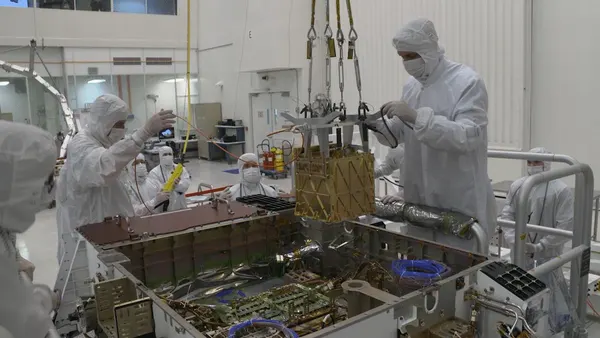
NASA’s MOXIE finished its work on Perseverance with a 16th run on Aug. 7, 2023, making 9.8 grams of oxygen. Over its whole mission it produced 122 grams, which NASA compared to what a small dog breathes in 10 hours. Its best rate was 12 grams an hour, twice the original goal, at 98 percent purity or better.
That is a real result, and it is easy to oversell in both directions.
What it proved: solid oxide electrolysis can pull oxygen off carbon dioxide drawn from the Martian air, on the surface, across a full Mars year of seasons and temperatures, and do it repeatedly. That’s the hardest kind of claim to make from a lab on Earth, because Mars dust, pressure swings and thermal cycling are hard to fake. MOXIE ran its compressor through all of it.
What it didn’t prove: anything about scale. MOXIE ran in short sessions because it shared power with a rover. A propellant plant has to run continuously for many months. Starship’s ship stage alone carries 1,600 tonnes of propellant when full, most of it oxygen. Suppose a surface departure needs only a few hundred tonnes of oxygen and the plant gets two Earth years to make it. That works out to well over 10 kilograms an hour, nonstop. MOXIE’s best hour was 12 grams, so the rate has to grow more than a thousandfold and the duty cycle has to go from occasional to permanent.
Scaling an electrochemical cell is not mysterious. You add cells, more power and better thermal management. The hard parts are the ones MOXIE was too small to meet: dust filtration at industrial airflow, cell degradation over thousands of hours, and the power source. At plant scale the reactor, not the chemistry, is the long pole.
Our view: MOXIE retired the “does it work on Mars” risk and nothing else. That’s worth a lot. The next useful milestone is a lander-scale unit running for months on its own power, and no such mission is funded today.
What would change our mind: a funded Mars ISRU pathfinder in the kilogram-per-hour class with a launch date. That would move Mars propellant from slideware to schedule.
Not affiliated with NASA, SpaceX or any agency or company mentioned. Not investment advice. Disclaimer.