
MMX is heading for Phobos, and its sample could settle a resource question
JAXA's sample-return mission launched Oct. 19. Whether Phobos is a captured asteroid or Martian debris changes what it's good for.
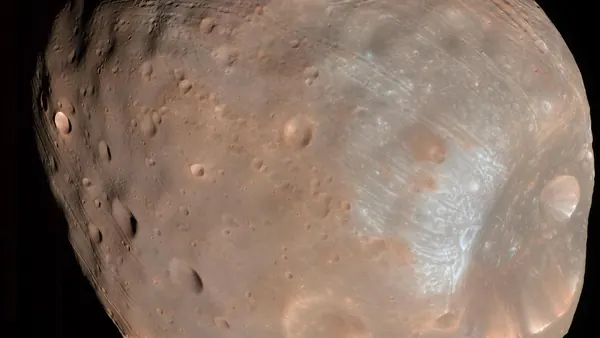
Japan’s space agency JAXA launched the Martian Moons eXploration mission on the afternoon of Oct. 19 (EDT). MMX won’t land on Mars. It’s headed for the planet’s two moons, Phobos and Deimos, and it’s built to scoop material from Phobos and bring it back to Earth. SpacePolicyOnline notes it carries two NASA instruments, and ESA marked the liftoff as well.
Phobos has an identity problem, and a sample is the cleanest way to fix it. One camp thinks it’s a captured asteroid. Another thinks it re-formed from debris blasted off Mars by a large impact. These aren’t trivia answers for anyone interested in resources. A captured carbon-rich asteroid parked in Mars orbit would be a convenient test bed for the asteroid-mining crowd. A ball of Martian ejecta would be a sample of Mars you can reach without fighting Mars’s gravity on the way back up.
Phobos also keeps turning up in Mars architecture studies as a possible depot, mainly because leaving it costs so little energy. Depots need something to store, though. If the returned material holds water-bearing minerals, the idea gets a lot more interesting. If it’s dry rock, Phobos becomes a parking spot rather than a resource.
We’ll hold our opinion on the depot idea until the lab results come in. A dry, ordinary sample would make us much less interested.
Mars Mining Co. is an independent news site. It is not affiliated with NASA, JAXA, ESA, SpaceX or any company mentioned. Nothing here is investment advice. Full disclaimer.