
Asteroid mining economics: start with the 121.6 grams
The best-funded asteroid sample return in history brought back about a quarter pound. Here's what that tells you about metal-asteroid pitches.
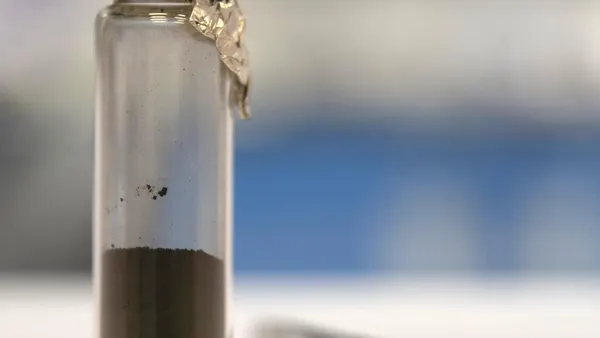
NASA’s OSIRIS-REx dropped its capsule in the Utah desert on Sept. 24, 2023, and when the agency finished weighing the contents it announced 121.6 grams of asteroid Bennu, about double the mission’s 60-gram requirement. It was a triumph. It was also a multi-year round trip for a quantity you could mail in an envelope.
Keep that number in your head whenever someone values an asteroid in quadrillions of dollars. Those figures multiply an estimated mass by a spot price for nickel or platinum, which tells you nothing. Selling that much metal would collapse the price long before delivery, and the cost of moving it is the whole business.
Asteroid economics comes down to three variables. Delta-v, the velocity change needed to reach the rock and come back, which for some near-Earth asteroids is lower than for a round trip to the lunar surface. Trip time, which for those same asteroids is measured in years because favorable launch windows are rare. And product, which splits into two very different businesses.
The first business is volatiles for use in space. Carbon-rich asteroids like Bennu carry water locked in their minerals. Water sold in orbit as propellant doesn’t need to survive reentry or find an Earth buyer. Its competitor is Earth launch, and as our Starship math piece argues, that competitor keeps getting cheaper.
The second is metals for Earth. Here the exemplar is 16 Psyche, the metal-rich asteroid NASA’s Psyche spacecraft is due to reach in August 2029 after launching on Oct. 13, 2023. Psyche is a science mission. It will tell us what a metal-rich body is actually made of, which is the prospecting survey the metal business needs and doesn’t have.
The startup test
AstroForge is the company most loudly attempting the metals route. Its first deep-space probe, Odin, launched Feb. 26, 2025, and was lost before its planned flyby. The company published a long public debrief, and its CEO told Payload that the last contact came at about 850,000 km and that the next attempt would be a roughly 200 kg spacecraft with a price tag under $10 million. That cost discipline is the interesting part. If deep-space prospecting can be done for single-digit millions per attempt, failing a few times is survivable.
We think asteroid metals for Earth markets remain a 2040s question at best, and water-for-propellant asteroids only pay if there’s a customer in cislunar space first. That makes the lunar economy a prerequisite for the asteroid one, not a rival.
What would change our mind: a sub-$20 million commercial probe that reaches a target asteroid and returns compositional data good enough to book reserves against.
Not affiliated with NASA, SpaceX or any agency or company mentioned. Not investment advice. Disclaimer.